
 By Magdalena Sanchez
Culture That Kills: Symbols, Discourses, and Silences
Violence is often associated with physical, visible acts. But this is only the tip of the iceberg. Beneath it—sometimes visible and sometimes invisible—long before a fist is raised and leaves a bruise, or a bullet is fired leading to femicide, there has been a lengthy cultural process that normalizes and legitimizes that aggression. Culture, in its broadest sense—composed of symbols, discourses, rituals, and beliefs—is a battlefield where struggles for power unfold, producing either oppression or liberation. This essay explores how cultural violence functions as a framework that legitimizes structural and direct violence, and how counterculture rises as a force of resistance.
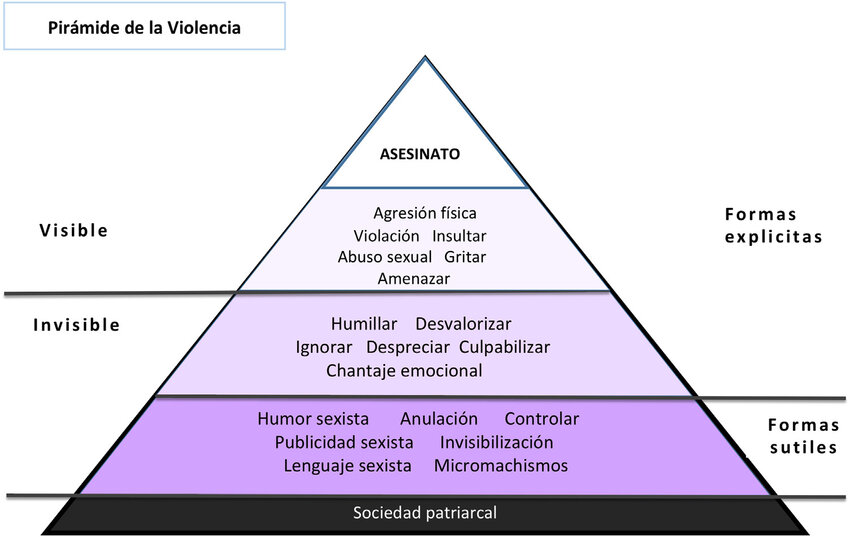
To understand how invisible violence can tacitly excuse a series of actions that may culminate in femicide, we will discuss rape culture as a clear example of this phenomenon. Here, we are not referring to visible aggressions such as threatening, hitting, or insulting, but to the set of beliefs that minimize, excuse, and justify visible violence. In other words, we are discussing invisible violence, that which is constructed through subtle mechanisms in daily life. We encounter this invisible violence in music, with songs that sexualize aggression and trivialize consent. We see it in crude humor, sexual innuendos, and jokes that reinforce stereotypes and minimize gender-based violence, turning aggression into a matter of ridicule. We see it in the media, which frequently revictimizes survivors, questions their testimonies, and focuses the narrative on the aggressor. And we even find this kind of invisible violence in religion, where certain interpretations have historically justified the subordination of women to men and often perpetuate the idea that women are the property of men. Anthropologist Rita Laura Segato explains that this is rooted in a “pedagogy of cruelty,” where the “mandates of masculinity” demand a constant demonstration of power—often exercised against women—in order to assert one’s place within a gender hierarchy [1].
This dynamic aligns perfectly with the sociologist Johan Galtung’s theory of violence. For Galtung, three interconnected forms of violence coexist within a triangle: direct violence (visible and physical), structural violence (social injustice, inequality), and cultural violence (the set of symbols that legitimizes the other two) [2]. Discourses that trivialize violence, gender stereotypes, and the silence surrounding victims form the cultural basis that legitimizes unequal opportunities (structural violence), which ultimately manifests in acts of direct aggression. A classic example is the historical silence surrounding women’s role in society, which has justified their exclusion from public and political life for centuries.
Language is a fundamental tool in this power struggle. As philosopher Ludwig Wittgenstein stated, “the limits of my language mean the limits of my world.” Reality is, to a great extent, a linguistic construction. Hence the crucial phrase: “what is not named does not exist.” When there are no words to describe the experience of a woman who is harassed or abused, that reality becomes invisible—erased from public discourse. Silence is not merely the absence of voice; it is an active form of violence that denies the existence of oppression. Graciela Hierro, one of the pioneers of Latin American feminism, emphasized the need to create a philosophical framework capable of naming and organizing women’s experience of invisibility and silencing in order to transform it [3].
Yet every dominant culture gives rise to a counterculture. This is the vital, creative force that challenges oppressive narratives. Art, in all its forms, becomes a powerful weapon. Murals, songs, films, and novels that make violence visible, denounce injustice, and construct new realities become potent tools of resistance and education that break the culture of silence. In conclusion, violence is not an accident but the manifestation of a deeply rooted cultural system. The symbols, discourses, and silences that shape rape culture and Galtung’s cultural violence serve as the scaffolding that sustains inequality and aggression. Yet we are not condemned to remain within this system. Counterculture—fueled by art, narrative, and critical thought—offers the tools to dismantle that scaffolding, to name what has been silenced, and to build a culture of life where equality and respect become the only language. The true revolution, in the end, is cultural.
References
https://www.sciencedirect.com/science/article/pii/S0212656724000453
Rita Laura Segato, La guerra contra las mujeres. Editorial Traficantes de Sueños, 2016.
Johan Galtung, Violencia cultural. Editorial Icaria, 2003.
Graciela Hierro, Ética y feminismo. Colección La Fuente, UNAM, 1985.