
 By Magdalena Sanchez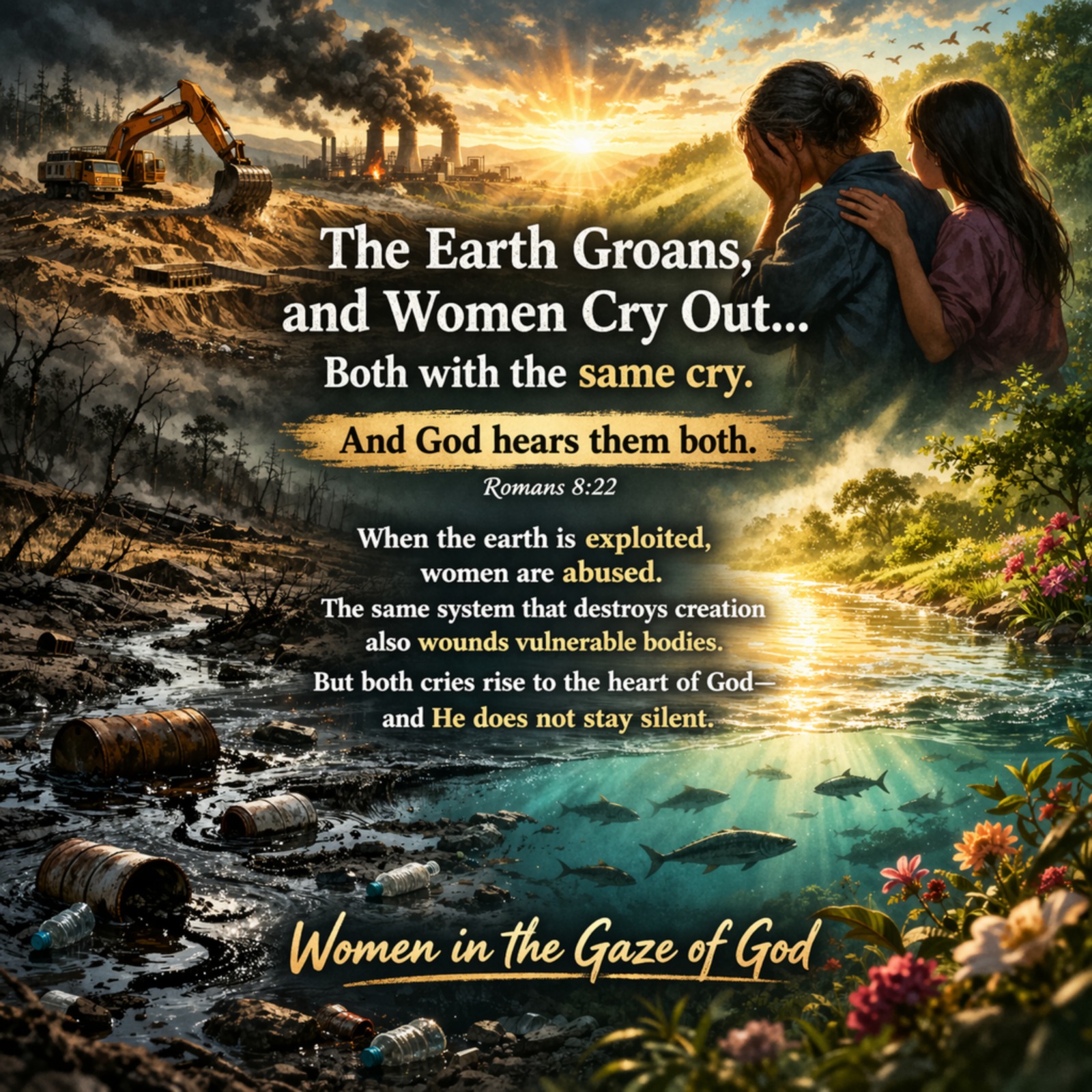
Guadalupe lived in a rural community in Latin America. Her life was deeply
tied to the land: she cultivated it, cared for it, and sustained her family from what the earth
provided. But one day, the machines arrived.
First came the noise.
Then the dust.
Then the water was no longer clean.
A mining company began operating near her community. Rivers became contaminated, the
land stopped producing as before, and life changed. But it was not only the land that suffered.
With the arrival of outside workers came new forms of violence. Women began to feel
unsafe. Some were harassed. Others were abused. Girls could no longer walk alone. Fear
settled into the community.
María expressed it in simple, yet deeply truthful words:
“They took our land… and also the peace of our bodies.”
Her story is not isolated.
It is part of a deeper wound.
There are pains that cannot be hidden.
Pains that do not always have words but are felt in the body… and in the earth.
The earth groans.
And so do women.
This is not a coincidence.
In many parts of the world, the exploitation of the earth and violence against women go hand
in hand. Wherever land is drilled, bodies are often violated. Wherever wealth is extracted,
human impoverishment follows.
What is done to forests is done to women.
Invaded, exploited, discarded.
From an ecofeminist perspective, Ivone Gebara has pointed out that this connection is not
accidental but structural: the same system that allows the domination of nature also
legitimizes the subordination of vulnerable bodies.¹ Likewise, Leonardo Boff denounces that
we live under a paradigm of conquest, where everything — land, bodies, life — can be
appropriated and used.²
And perhaps most painfully, this often happens under a language that claims to be moral,
even religious.
Systems that destroy are blessed.
Women’s suffering is spiritualized.
Silence is demanded where there should be resistance.
But Scripture offers us a different vision.
In Romans 8, Paul speaks of a creation that “groans in labor pains,” waiting for redemption.
This groaning is not only ecological; it is profoundly human. It is the same cry of Guadalupe.
The same cry of countless women whose bodies have been wounded, used, silenced.
It is a cry that may not reach institutions.
But it reaches God.
God hears what the world ignores.
God sees what others choose not to see.
A liberating spirituality cannot separate these pains. It cannot speak of justice without
including the earth, nor of creation without including bodies. It cannot preach love while
tolerating structures that produce death.
Because both pains are intertwined.
And both cry out for redemption.
From the theology of care, we are called to live differently: not from domination, but from
relationship; not from exploitation, but from care.
To care for the earth is to resist its destruction.
To care for bodies is to denounce their abuse.
To care for life is to stand with those who suffer.
God sees.
God hears.
And God does not remain silent.
The question is whether we are willing to listen…
and to respond.
Footnotes
- Ivone Gebara, Longing for Running Water: Ecofeminism and Liberation
(Minneapolis: Fortress Press, 1999), 35–38. - Leonardo Boff, Ethics and Moral Values: In Search of Foundations (Maryknoll: Orbis
Books, 2001), 45–50.