
 By Magdalena Sanchez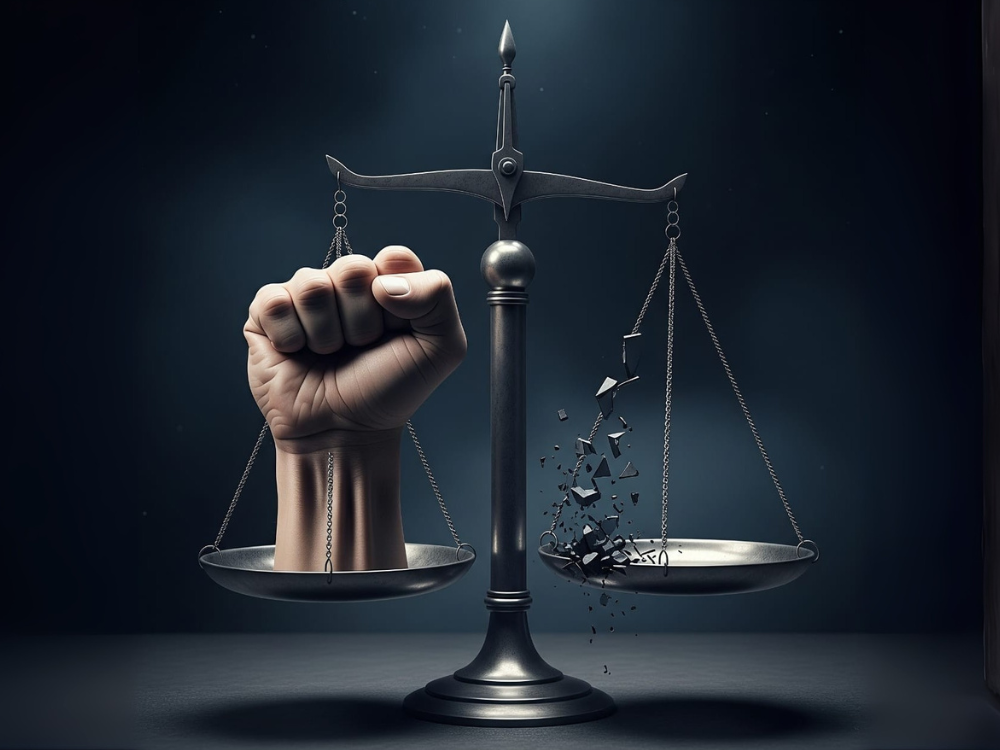
“The law has been written with masculine hands, from masculine logics, to guarantee the order that best serves power.” – Alda Facio¹
When the Law Also Hurts
The law is often represented as a woman with her eyes covered, a symbol of impartiality.
But for many women who have suffered violence, that blindfold does not signify justice… but blindness. A blindness that does not see the fear in the eyes of a battered woman. That does not hear the muffled cries of an abused teenage girl. That does not understand the loneliness of a victim who finds the courage to report, only to be questioned, judged, and revictimized.
For many, the law is not a refuge, but a second aggression.
For centuries, the legal system was built without women’s voices. Alda Facio explains it clearly: the law was developed from an androcentric vision that places the white, property-owning, heterosexual male as the “universal subject” of the law¹. Everything that falls outside that mold has been considered suspicious, inferior, or disposable.
That legal structure does not vanish on its own. It persists in regulations that demand “conclusive evidence” before believing a victim; in rulings that call femicides “crimes of passion”; in police officers who ask, “And why didn’t you defend yourself?”
Lucía Pérez was 16 when she was drugged, raped, and murdered in Argentina.
In 2018, the judges acquitted the defendants of the sexual crime, claiming there was no proof that Lucía “did not consent”³. As if a drugged teenage girl could give real consent. As if the silence of a dead minor were evidence in favor of the aggressor.
The judicial logic that requires victims to fight tooth and nail, to scream, escape, and return unharmed to tell what happened, is cruel. It ignores that fear often paralyzes. That abuse is subtle, repeated, progressive. That trauma does not always leave visible marks, but it does leave deep scars on the soul.
Reporting is not easy. For many women—especially Indigenous, migrant, or low-income women—it means navigating a hostile maze: officials who do not listen, agents who do not believe them, invasive examinations, endless waits, and trials where their entire lives are placed under the microscope.
In the United States, many Indigenous women have reported that their cases of sexual abuse are ignored by the federal justice system.
On reservations, victims are trapped in a legal limbo without real access to protection or justice⁴.
And in El Salvador, there are women imprisoned after suffering spontaneous miscarriages. They are convicted of “aggravated homicide” under laws that treat any pregnancy loss as a crime⁵. The law, far from protecting them, punishes them in their most vulnerable moments.
Feminist legal theory proposes a profound transformation of the legal system: that laws be grounded in women’s lived experience rather than in the denial of it. Catharine MacKinnon denounces how the law has systematically ignored sexual violence by treating it as something private, trivial, or inevitable⁶. And Kimberlé Crenshaw insists that not all women experience the law in the same way: race, origin, poverty, and language intensify institutional violence⁷.
We need a justice system that is not only punitive, but restorative. One that focuses on repairing harm, restoring relationships, and returning dignity. In Colombia, for example, restorative justice circles have been implemented with community participation and a therapeutic approach for women survivors of domestic violence⁸.
When a woman who has been abused dares to speak, and the law responds with disbelief, technicalities, or punishment, it is not only the system that fails: we all fail. Every unjust ruling, every aggressor who walks free, every victim humiliated, weakens the hope of those who come after.
But there are pathways forward. Women who fight, who report, who transform pain into strength.
And there are voices —like yours and mine— that can join together to change this story. True justice is not the one that punishes blindly. It is the one that looks suffering in the eyes… and acts.
References:
- Alda Facio, El derecho humano de las mujeres a una vida libre de violencia (San José: IIDH, 2006), p. 16.
- El País, “La justicia absuelve a los cinco acusados de violación grupal en Sabadell”, 4 de abril de 2022.
- Página/12, “El nuevo juicio por el feminidio de Lucía Pérez”, 2023.
- Áreas silvestres de mujeres nativas, estadísticas de MMIW , 2022.
- Human Rights Watch, “Estoy viva, pero soy como si estuviera muerta” , 2020.
- Catharine MacKinnon, Feminismo sin modificaciones: discursos sobre la vida y el derecho (Cambridge: Harvard University Press, 1987), pág. 39.
- Kimberlé Crenshaw, “Mapping the Margins: Interseccionalidad, políticas de identidad y violencia contra las mujeres de color”, Stanford Law Review , vol. 43, núm. 6 (1991), págs. 1243-1245.
- Dejusticia, “Justicia restaurativa en Colombia: una alternativa con enfoque de género”, 2021