 By Magdalena Sanchez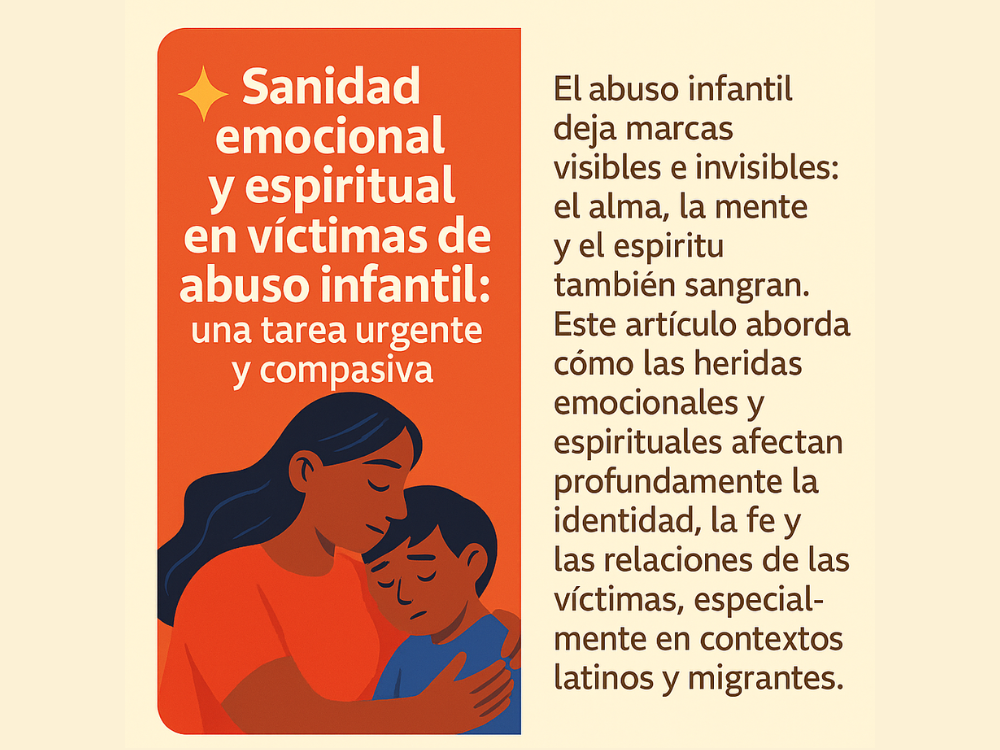
1 Introduction: Visible and Invisible Wounds
Child abuse leaves scars that go far beyond the physical: the marks on the body may be visible, but the wounds of the soul, mind, and spirit often remain silent and unseen. In Latin American contexts, in migrant communities in the U.S., and in other parts of the world, these wounds intertwine with cultural, religious, and social identities—sometimes deepening the harm, and other times offering pathways toward healing when approached with sensitivity.
Victims often feel that their sense of worth, their trust in others, and even their relationship with the sacred have been fractured. Questions like “Why did God allow this?” or “What did I do to deserve this?” become persistent companions. Supporting emotional and spiritual healing means acknowledging these invisible wounds, validating them, and offering a path of restoration that includes mind, emotion, and faith.
2 Global, Latin American, and U.S. Statistics on Child Abuse
To grasp the urgency of the issue:
According to the World Health Organization (WHO), 6 in 10 children under age five worldwide suffer physical or psychological violence at the hands of parents or caregivers. ¹
Globally, an estimated 12–19% of girls and approximately 7–8% of boys have experienced sexual abuse during childhood. ²
In Latin America and the Caribbean, nearly 2 out of 3 children ages 1–14 experience violent discipline at home (corporal punishment or psychological aggression). ³
In the same region, the homicide rate for children and adolescents (12.6 per 100,000) is roughly four times higher than the global average. ⁴
In the United States, an estimated 1 in 4 girls and 1 in 13 boys will experience sexual abuse during their childhood. ⁵
These figures reveal that child abuse is a global reality that knows no borders. Yet the resources available, institutional responses, and cultural or logistical barriers vary dramatically from country to country, making a contextualized approach essential.
3 The Emotional Dimension of Trauma and Its Spiritual Impact
Child abuse causes profound emotional harm: chronic fear, guilt, shame, feelings of worthlessness, anxiety, depression, dissociation, interpersonal difficulties, and low self-esteem. This emotional damage often affects cognitive functioning (negative thoughts, distorted self-beliefs) and physical functioning (nervous system hyperactivation, sleep disturbances, somatization).
But there is another level of harm: spiritual harm. In communities with strong religious identity, faith can be a source of comfort, but it can also become a site of pain and confusion. Some abusers misuse religious authority or misinterpret the Bible to justify their actions, leading to a rupture in the victim’s image of God. Survivors may no longer be able to see God as provider, protector, or as a God who upholds justice. People who once found comfort in rituals, prayer, or faith communities may now feel mistrust, shame, or a belief that God failed them.
4 Psychological First Aid for Child Abuse Survivors
Timely and appropriate intervention can make a crucial difference in a child’s emotional, spiritual, and even physical recovery. Key steps include:
Safety and containment: Ensure the child is out of immediate danger. Create an environment where they can express themselves without fear, supported by a calm, empathetic adult who listens without judgment.
Validation of pain: Tell the victim explicitly that what they experienced was abusive harm and that it was not their fault, and affirm that their emotions are legitimate. Help the victim break the internal silence.
Crisis regulation: Use simple techniques to calm emotional activation, such as deep breathing, guided pauses, grounding with a tangible item (a blanket or meaningful object), or exercises that help reduce anxiety.
Protection of confidentiality and respect: If mental health professionals or leaders from a church or faith community are involved, it is essential to clarify which parts of the situation will be shared, to respect the victim’s privacy, and under no circumstances expose them further.
Professional referral: Whenever possible, connect the child with psychologists or therapists experienced in childhood trauma. If resources are limited, and faith community leaders are involved, these leaders, counselors, or ministers must receive proper training and supervision.
These first steps do not solve everything, but they significantly reduce the risks of long-term dissociation, suicidality, deep withdrawal, or revictimization.
5 Long-Term Therapeutic Support with Cultural Sensitivity
The healing process must be individualized and culturally responsive:
Post-abuse healing models: Frameworks that guide survivors through acknowledging harm, rebuilding identity, and envisioning a future. For example, Draucker et al.’s model⁶ emphasizes exploring and reorganizing the survivor’s life narrative—including trauma—in ways that restore meaning and support healing. This can be adapted to integrate cultural and spiritual values.
Attachment and relational therapies: When abuse has damaged core relationships (with parents, caregivers, or authority figures), rebuilding healthy relationships becomes essential. Family therapy or attachment-based interventions can play a key role.
Narrative, creativity, and expression: Survivors benefit from telling their stories at their own pace through therapeutic writing, art, music, dance, or theater. In Latin America, oral storytelling, community art, and music can serve as powerful healing tools.
Post-traumatic growth: Some survivors transform their pain into purpose—serving others, raising awareness, participating in ministries or social causes. This “active hope” becomes a source of life even in the midst of suffering.
6 Spiritual Harm, Wounds of Faith, and the Phenomenon of Spiritual Abuse
Spiritual abuse occurs when religion, ecclesial authority, or biblical interpretations are used to manipulate, silence, or blame the victim. This may be explicit—such as a leader demanding silence or misusing doctrine to justify violence—or implicit, through teachings that make the victim feel sinful, tainted, or unworthy of approaching God.
Spiritual wounds may include:
A distorted image of God (seen as permissive of evil, distant, or punitive).
A sense that faith is no longer meaningful → withdrawal from church → spiritual isolation.
Difficulty praying, reading Scripture, or participating in faith communities without triggering trauma.
Pastoral support in this area requires humility: listening without preaching, allowing survivors to voice difficult questions, and welcoming expressions of anger, doubt, and mistrust.
7 Pathways Toward Spiritual Restoration in Multicultural Contexts
Possible strategies include:
Recognizing the spiritual wound: Acknowledge its legitimacy; avoid dismissing it as “lack of faith” or “spiritual immaturity.”
Adaptive rituals and spiritual resources: Healing prayers, lectio divina centered on compassion texts (Psalm 23, Psalm 34, Isaiah 43:2), or community liturgies where survivors can express their pain before God and the faith community.
Reflective forgiveness and justice: Understanding that forgiveness is not forgetting nor minimizing harm, and must only occur when the survivor is ready. Promote justice—not only mercy—to honor the dignity of the victim.
Restorative communities: Build churches or faith spaces that are genuinely safe, with abuse-prevention protocols, trauma-informed leaders, and cultural sensitivity (language, traditions, customs) especially in Latinx and migrant communities.
8 The Role of the Faith Community in Latin America, the U.S., and Globally
The church has an essential role:
As a place of listening and validation (“Here, I can bring my pain.”)
As a bridge between the emotional and the spiritual, integrating psychological and spiritual healing.
As a promoter of prevention: teaching healthy boundaries, signs of abuse, and children’s right to dignity.
In the U.S., many Latinx communities face barriers such as language, limited access to mental health services, and discrimination. The church can help connect families to resources, translate, educate, and accompany them in culturally sensitive ways.
Globally, collaboration among churches, nonprofits, and public mental health services is needed to create support networks and protocols that transcend borders.
9 Ethical Challenges, Limits, and Best Practices
- Do not impose religious beliefs or doctrines that revictimize.
- Respect the survivor’s autonomy and pace.
- Train caregivers, pastors, counselors, and psychologists in trauma-informed care; encourage self-care and professional supervision.
- Know when to refer to clinical specialists.
- Avoid unnecessary exposure, forced testimonies, or community pressure to “heal quickly.”
- 10 Conclusion: Shared Hope and Collective Responsibility
Child abuse is not an isolated phenomenon restricted to one country, culture, or socioeconomic class. It is a global crisis with human faces in Latin America, the United States, Indigenous communities, and migrant families. Yet where pain is acknowledged, healing can begin; where communities respond with truth, compassion, and justice, restoration becomes possible.
As believers, we are called not to look away. We are called to transform pain into words, action, prayer, and solidarity. To trust that God does not abandon the one who suffers, that divine justice restores, and that God’s promise of life is real and extends beyond the wound.
May this shared hope move us from concept to action—through listening, accompaniment, training, and prevention. Emotional and spiritual healing is not a privilege for a few, but a divine right of every child, every survivor, every wounded human being.
References
- World Health Organization, Child maltreatment fact sheet, Nov. 2024. “Child maltreatment is the abuse and neglect that occurs to children under 18 years of age…”. Disponible en: WHO. World Health Organization
- Meta-análisis sobre abuso sexual infantil (global) estimado entre 12-19 % para niñas, 7-8 % para niños. Datos compuestos de varias fuentes. World Health Organization+2Wikipedia+2
- UNICEF, “A Statistical Profile of Violence against Children in Latin America and the Caribbean”: casi 2 de cada 3 niños entre 1 y 14 años sufren disciplina violenta en el hogar. UNICEF+1
UNICEF / MINORI, tasa de homicidios de niños y adolescentes 12.6 por 100,000 en Latinoamérica y el Caribe, cifra 4 veces mayor al promedio global. UNICEF DATA+1
En EE. UU., estimaciones de abuso sexual infantil: 1 de cada 4 niñas, 1 de cada 13 niños. Datos de CDC / National Children’s Alliance. National Children’s Alliance
Carla B. Draucker et al., “Theoretical Modeling of Posttraumatic Outcomes in Survivors of Interpersonal Violence,” Journal of Trauma & Dissociation 10, no. 3 (2009): 297–321, https://doi.org/10.1080/15299730903018417.