
 By Magdalena Sanchez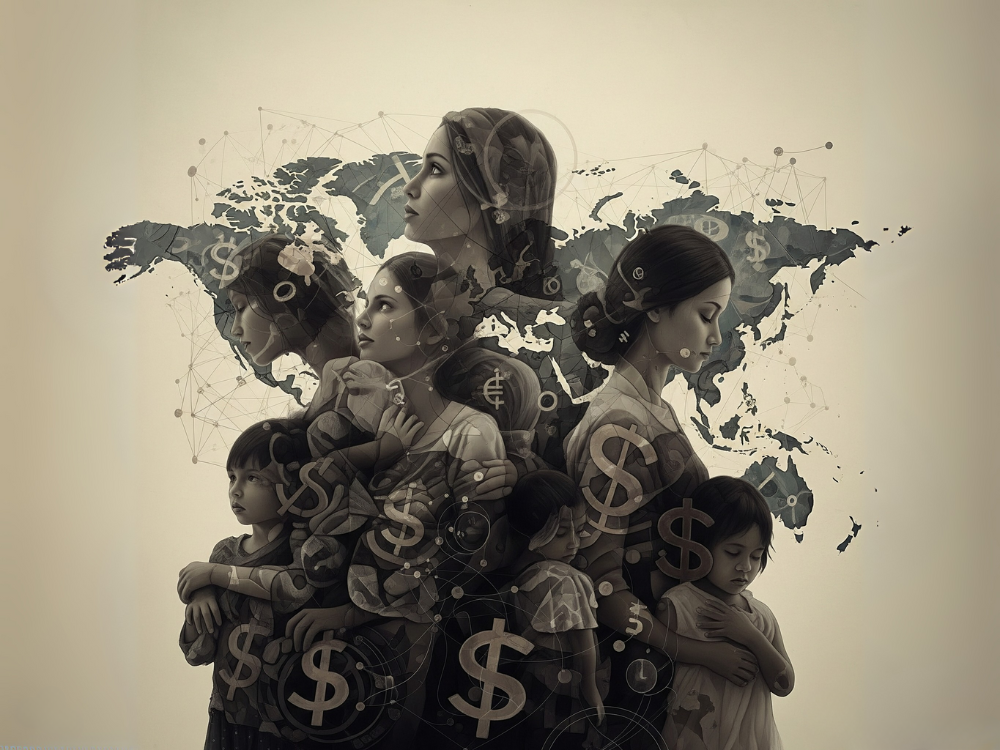
“The lives of many women don’t suddenly break down. They wear away silently, between borders, factories, rented beds, and prayers without consolation.”
When we talk about violence, we often think of blows, shouting, and visible scars. But there are forms of violence that aren’t visible to the naked eye because they’re normalized, because they’re part of the machinery of the world as we know it. This is the second blog post in our series Structures of abuse: the invisible pillars of violence, and today we want to look squarely at a structure that runs through all the others: global capitalism, and its devastating capacity to turn bodies—especially those of women, girls and boys and young people—into a source of profit.
We’re not talking about abstract ideas. We’re talking about real stories.
We are talking about the young Honduran woman who crossed two countries with the promise of a decent job, and ended up trapped in a brothel.
Of the single mother who cleans other people’s houses for pennies while someone profits from her precarious situation.
About the twelve-year-old girl who was sold online by a relative.
The migrant woman who agreed to rent her womb because she had no other way to feed her children.
About the indigenous teenager who disappeared on her way to the city.
The woman who sold her body for years to survive, and upon arriving at the church heard that “she must repent.”
These stories are not system errors. They are the system working as it was designed.
The global market of inequality
Capitalism, from its origins, has needed docile, invisible, and available bodies. Silvia Federici states it clearly: the woman’s body was the first colonized territory. In the transition to modern capitalism, women were stripped of power, land, and autonomy, and their role was reduced to reproduction and service.¹
Today, that logic hasn’t disappeared. It has only become more sophisticated. Global capitalism has built transnational networks of sexual and labor exploitation, where the female body is raw material, a source of pleasure, an object of consumption, a profitable commodity. And that body, as Rita Laura Segato points out, is also a symbol: it becomes a message of power used to discipline other women.²
Prostitution, pornography, human trafficking, sex tourism, surrogacy, and erotic content platforms are not isolated phenomena. They are part of the same system that disguises slavery as “free choice” and hides suffering behind discourses of “empowerment.”
As Verónica Gago points out, the structural violence of the market is not only imposed from the outside; it is internalized, accepted, and normalized³. Debt, poverty, hunger, displacement… everything becomes a form of control.
And it is there, precisely there, where many women, migrants and girls are exploited doubly or triply: because of their gender, because of their origin, because of their poverty.
The silence of the church: when silence is also violence
In the midst of this globalized system of abuse, the church often remains silent. A silence that hurts. That covers up. That protects structures more than people.
How many times have we heard generic phrases about “exploited women” but failed to name the exploiters?
How many times have we preached about forgiveness without speaking of justice?
How many times have we welcomed a victim only to demand that they be quiet, that they “recover” quickly, that they not cause any inconvenience?
The silence of the church is not neutral. As Elsa Támez affirms, it is a form of structural violence⁴. It becomes complicit with the system when injustice is not named, when networks are not denounced, when safe spaces are not opened to listen and accompany without judgment.
And worse still: when submission is spiritualized, when obedience is demanded from women who only know submission, when resignation is preached to those who have been forced to survive.
Jesus never blessed violence. He never looked the other way. He touched the excluded woman. He listened to the foreigner. He wept with the victims. He denounced those who profited from faith. And he drove the merchants out of the temple because commerce has no place in the house of the God of life.
A faith that embraces wounded bodies
We cannot speak of the gospel if we do not embrace with dignity the women, girls, boys and young people who have been treated as merchandise.
We cannot talk about justice without mentioning modern slavery.
We cannot speak of “spiritual liberation” while bodies continue to be objectified.
María Mies states it emphatically: capitalism needs impoverished and indebted women to sustain itself.⁵ That is why we cannot expect justice to come from the system. It must be born from below, from an embodied faith that dares to look at suffering without disguise.
As Ada María Isasi-Díaz said,Women’s spirituality is born from everyday life, from struggle, from the caring community⁶.
That is the spirituality we need:
One that doesn’t judge, but listens.
One that doesn’t preach about women, but with them.
One that does not glorify poverty, but fights against it.
One that does not spiritualize abuse, but denounces it with courage.
One that says:Your body is sacred. Your story matters. Your dignity is not negotiable.
References:
- Silvia Federici, El calibán y la bruja: mujeres, cuerpo y acumulación originaria, Madrid: Traficantes de Sueños, 2010.
- Rita Laura Segato, La escritura en el cuerpo de las mujeres asesinadas en Ciudad Juárez, Buenos Aires: Tinta Limón, 2013.
- Verónica Gago, La potencia feminista: o el deseo de cambiarlo todo, Buenos Aires: Tinta Limón, 2019.
- Elsa Támez, Teología de la liberación para una nueva generación, San José: DEI, 2009.
- María Mies, Patriarcado y acumulación a escala mundial, Madrid: Horas y Horas, 2006.
- Ada María Isasi-Díaz, En la lucha: elaborando una teología latina desde la base, New York: Fortress Press, 1993.