 By Magdalena Sanchez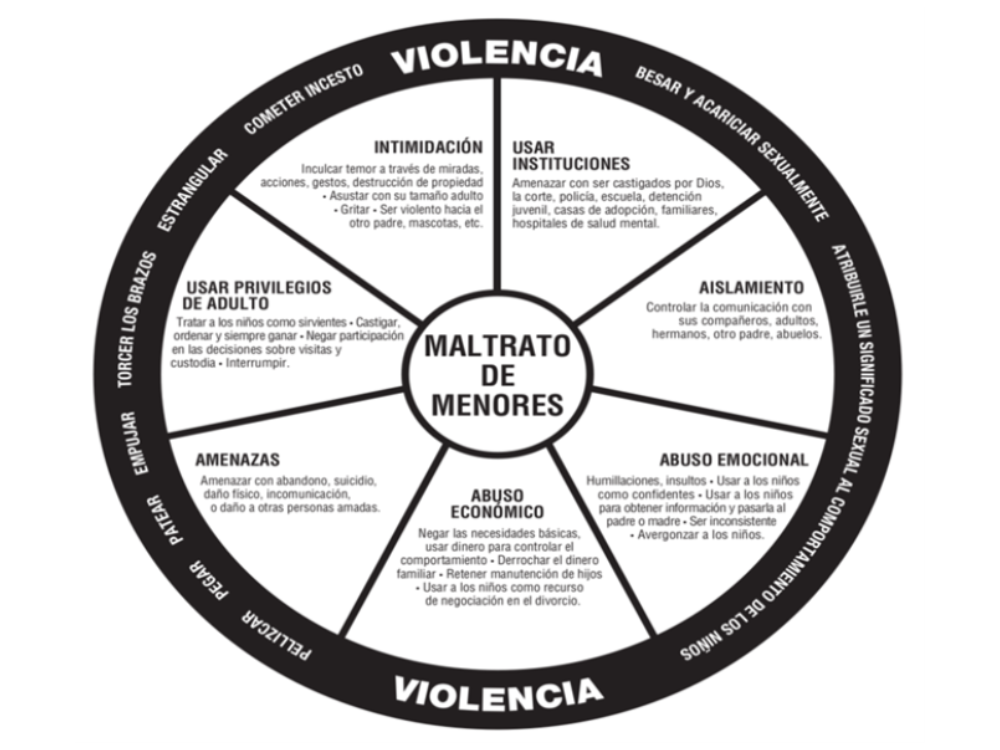
The Child Abuse Wheel is a painful mirror of a reality that far too often remains hidden behind the doors of homes, schools, and even temples. It is not only about visible blows or punishments. This wheel reveals a complex web of strategies through which an adult exerts dominance over a child, using fear, guilt, and manipulation as tools of control.
At the center of this wheel is child maltreatment—not as a single event but as a system. The adult, who should be a guide and protector, becomes a figure of absolute power. Each section of the wheel displays a different face of that power.
Intimidation is one of the most common and socially normalized forms. A raised voice, a threatening look, or a fist slammed against the wall is enough to impose silence. The child quickly learns to anticipate anger and adapt in order to survive. Their body obeys before their mind can understand, and their soul begins to associate love with fear.
The use of institutions adds another layer of abuse. Many adults invoke God, school, or the police as instruments of punishment: “If you don’t behave, God will punish you,” or threaten, “I’ll take you to the police.” These phrases—often considered harmless—plant in the child a distorted vision of power: the entire world becomes a stage where everyone has the right to punish them.
Isolation cuts off the relationships that could offer comfort or rescue. The child is forbidden to talk to friends, siblings, or grandparents. Their world shrinks to the control of the one who dominates them. Loneliness becomes a way of life.
Emotional abuse leaves wounds that are invisible yet enduring. Humiliating, insulting, using a child’s insecurities to mock them, or forcing them to carry adult problems as confidants, destroys their sense of safety. Many children grow up believing that their worth depends on their abuser’s approval or that they deserve the treatment they receive. When they are told, “You’re worthless,” or “I regret having you,” those words become embedded in their identity as if they were truths.
Economic abuse also has a child’s face. It appears when children are denied basic needs, when money is used to manipulate, or when they become tools of revenge between parents. “If you don’t do what I say, I won’t buy you anything,” or, “Don’t give your kids money; I forbid it,” turn financial provision into a weapon of control.
Threats and the use of adult privilege consolidate domination. The adult imposes authority without dialogue, uses fear of loss or abandonment, and teaches that power is not shared. Thus the child learns that their voice does not matter and that love must be earned through absolute obedience.
On the outer edge of the wheel appear physical and sexual violence—the most visible, but not the only forms. Hitting, shoving, pinching, inappropriate touching, or sexualized language are extreme expressions of the same logic: the child’s body does not belong to them, but can be controlled, used, or punished.
The damage left by this system is profound. Survivors may grow up with guilt, anxiety, or an inability to trust. But there is also hope. Naming violence is the first step toward breaking its power. Each word in this diagram can become awareness, and each awareness can spark transformation.
Understanding this wheel opens our eyes to a spiritual truth: power without love destroys, but love without justice also wounds. To educate, to raise, to correct must never mean to dominate, but to accompany. Healthy authority protects; it does not humiliate. Loving discipline guides; it does not crush.
May this wheel help us recognize where harm begins and how we can transform it.
May it remind us that children are not property or projects; they are persons with dignity, rights, and a voice. And may it teach us that the true power of an adult lies not in control, but in care.